10 min read
Crypto investing with an index or by picking coins: what changes when rules decide?
A crypto index holds coins chosen and weighted by published rules, and changes them on a schedule. It takes over the hardest calls in picking coins: what to buy, how much and when to offload. It does not take away volatility. Most of the weight still sits in the largest assets.

In this article we cover:
- What is a crypto index, and how is it different from picking coins?
- Are there supervised or managed crypto investment products in India similar to mutual funds for long-term wealth creation?
- Why is picking coins harder than it looks?
- Which platforms offer pre-built crypto portfolios or “baskets” designed by experts instead of DIY coin picking?
- Are there apps in India that auto-rebalance a crypto portfolio periodically according to a defined strategy?
- What does a crypto index not protect you from?
- Which Indian platforms offer crypto index products so you don’t have to pick coins yourself?
Three ways to own a spread of crypto, side by side
The coins can overlap. What differs is who decides, and whether you can read the rules.
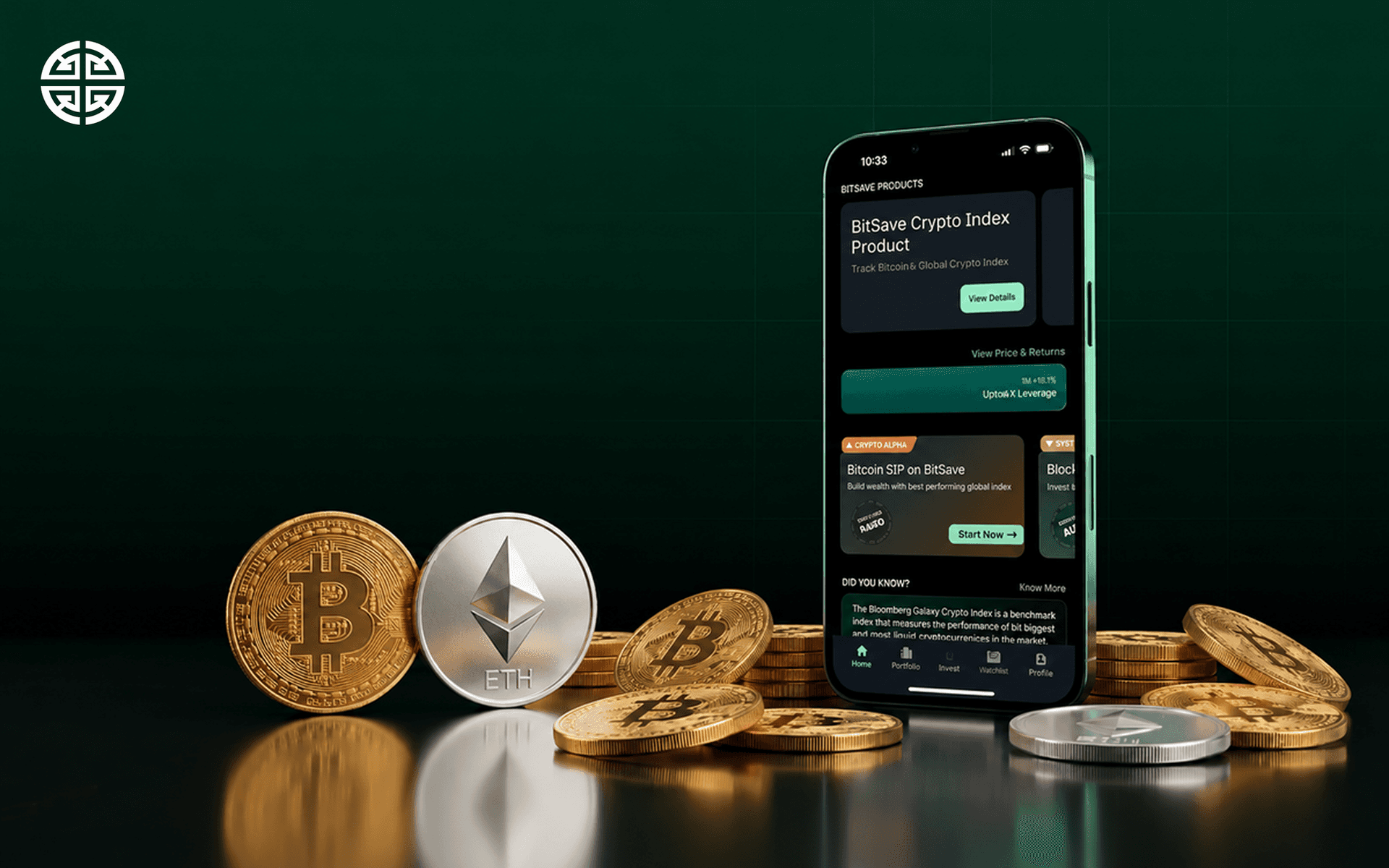
BitSave Crypto Index tracks the Bloomberg Galaxy Crypto Index, where Bloomberg, not BitSave, decides what is in it: up to 15 large-cap assets drawn from the top 25, no single asset above 35%, rebalanced monthly inside a unit token that is not taxed at each rebalance, held in institutional cold storage off BitSave's balance sheet.
What is a crypto index, and how is it different from picking coins?
A crypto index is a list of crypto assets chosen and weighted by published rules, and reviewed on a fixed schedule. Picking coins means making each of those choices yourself. A curated basket is chosen by a provider's team. An index is chosen by a rulebook anyone can read.
The rules answer four questions: what enters, how much weight it gets, what leaves, and when. Most crypto indices are weighted by market capitalisation, which is an asset's price multiplied by the number of units in circulation. The larger the asset, the larger its share of the index.
For BitSave Crypto Index, the rulebook is Bloomberg's. Bloomberg's index team decides the components of the Bloomberg Galaxy Crypto Index. BitSave does not. Why that matters, and why an index is not the same thing as a basket, is covered in the Bloomberg licence article. The rules do not know which coin will do best. They know which assets are largest, and they cap how much any one asset can carry.
The practical difference is that you can read what you are investing in before you invest. With picking coins, the rulebook is whatever you decide that month.
Are there supervised or managed crypto investment products in India similar to mutual funds for long-term wealth creation?
Not exactly in the mutual fund sense. SEBI does not regulate crypto investments in India, and no SEBI-regulated crypto fund exists. What exists are index and basket products offered by crypto platforms. The closest to a managed, rules-based product is a crypto index fund unit, whose value comes from the assets underneath.
With BitSave, what you own is a unit token: a digital record of your share of the pooled assets, held off BitSave's balance sheet. Each unit is priced once a day at its NAV, the net asset value of the assets behind one unit on that day.
The day-to-day mechanics will look familiar to anyone with a mutual fund SIP. You can invest through a crypto SIP, weekly or monthly, and each instalment buys units at that day's NAV. The same rupee amount buys more units when the NAV is lower and fewer when it is higher. The fee is an expense ratio charged daily on the NAV, not a commission on each trade. And the index is followed, not chosen: Bloomberg's rules decide what BitSave Crypto Index holds, the way an equity index fund follows an index it does not pick.
Two things differ. There is no SEBI investor-protection framework behind a crypto product. And gains are taxed under Schedule VDA: 30%, with TDS deducted on each sale and no offset for losses.
Why is picking coins harder than it looks?
Picking coins is five decisions, not one: what to buy, how much of each, when to add, when to sell, and when to rebalance back to your starting allocation. Each one comes back every time the market moves. Most people make the first decision and never return to the rest.
- What to buy. The list of crypto assets changes every year, and new ones arrive faster than old ones leave.
- How much of each. Your allocation starts to shift on the first day prices move.
- When to add. Each new rupee raises the same question again: into what, and in what proportion?
- When to sell. A coin that falls asks whether to cut it. A coin that rises asks whether to take profit.
- When to rebalance. If you hold the coins directly, every rebalance is a sale, and every sale is a tax event.
The market's own record shows why the later decisions matter. On CoinMarketCap's snapshot of 7 January 2018, 8 of that day's top 20 assets by market capitalisation were still in the top 20 on its snapshot of 20 September 2026. The other 12 had dropped out. Of the 12 that replaced them, 4 are stablecoins or exchange tokens and 8 are other crypto assets.
Picking well in January 2018 was not the same as picking well for the eight years that followed. A portfolio that stopped at the first decision would still hold the 2018 list. An index would have changed with the market, because its rules review what qualifies on a schedule.
A fair question is why not read the rules and copy the index yourself. The Bloomberg licence article linked above answers that too.
Which platforms offer pre-built crypto portfolios or “baskets” designed by experts instead of DIY coin picking?
Several Indian crypto platforms offer pre-built portfolios in two forms. A crypto basket is chosen and weighted by the provider's team. A crypto index is chosen and weighted by a published methodology. Both remove DIY coin picking. They differ in who decides, and whether you can read the rules.
Each route asks something different of you. Picking coins yourself asks for a decision every time the market moves. A basket asks you to follow the provider's choices and to check them when they change. An index asks you to accept a published rulebook, including its limits.
BitSave offers the index route. BitSave Crypto Index tracks an index whose rules Bloomberg publishes and runs. The fuller comparison of a basket and an index is in the Bloomberg licence article.
Are there apps in India that auto-rebalance a crypto portfolio periodically according to a defined strategy?
Yes. Rebalancing, the scheduled trimming of assets that grew and topping up of assets that lagged, is built into index products. BitSave Crypto Index rebalances monthly to the weights set by Bloomberg's rules. Because it happens inside the unit, the rebalance is not a taxable event for you.
Weights move away from target between reviews because prices move at different speeds. If one asset rises 40% in a month while the rest stay flat, it now carries a larger share of the allocation than the rule allows. Monthly crypto rebalancing brings each asset back within the index caps: no single asset above 35% or below 1%. At scheduled reviews, assets that no longer qualify leave and new ones enter.

If you hold the coins directly, the same rebalancing means selling. In India, gains on crypto fall under Schedule VDA, the tax category for virtual digital assets: 30% on gains, with TDS deducted on each sale and no offset for losses. Inside a BitSave unit, you are taxed when you sell your index units, not at each rebalance. The full arithmetic is in crypto tax in India: what every rebalance actually costs.
What does a crypto index not protect you from?
A crypto index does not protect you from a fall across the whole crypto market. Spreading money across up to 15 assets limits the damage one declining coin can do. But the largest assets carry most of the weight, and when they fall, the index falls with them.
Market-cap weighting is the reason. The same rule that keeps the index close to the market also concentrates it in the market's biggest names. Diversifying across crypto reduces single-coin risk. It does not reduce market risk.
An index also holds the market's winners and losers until the next rebalance. It does not react to news in between. There is also a cost. BitSave Crypto Index charges a 1.5% a year expense ratio, charged daily on the NAV, which a do-it-yourself holder does not pay. What that fee covers is set out in what a 1.5% crypto expense ratio actually buys you.
If your goal is a steadier ride, the index is not BitSave's lower-volatility route. BitSave's Crypto & Gold product is, and how a crypto and gold portfolio behaves over time explains why.
Which Indian platforms offer crypto index products so I don’t have to pick coins myself?
BitSave offers one. BitSave Crypto Index tracks the Bloomberg Galaxy Crypto Index (BGCI), administered by Bloomberg Index Services Limited. Bloomberg's index team decides the components, not BitSave: up to 15 large-cap assets from the top 25, no single asset above 35% or below 1%, rebalanced monthly.
You buy units in rupees and never pick or hold the coins yourself. The rules and product details are on the BitSave Crypto Index page, and Bloomberg lists the index on its BGCI page.
For a first-time crypto investor, BitSave's standing view is to start with Bitcoin and step up to the index later, for the reasons in Bitcoin and Ethereum for the long term.
The decision in front of you is not which coin. It is whether you want to make the five picking decisions yourself, month after month, or hand them to a rulebook and accept its limits. Either way, how much of your money goes into crypto matters more than which route you take. That question is covered in how much crypto should you hold.
Terms used in this article
Index: a list of assets chosen and weighted by published rules, reviewed on a schedule.
Market capitalisation: an asset's price multiplied by the number of units in circulation.
Allocation: how your money is divided between assets, usually stated as percentages.
Rebalancing: trimming assets that grew and topping up assets that lagged, back to the target allocation.
NAV (Net Asset Value): the value of the assets behind one unit on a given day. The current NAV is today's value. Your average NAV is the average price at which you bought your units. The gap between the two, divided by your average NAV, is your gain or loss.
Unit token: a digital record of your share of a product's pooled assets. The same rupee amount buys more units when the NAV is lower and fewer when it is higher.
Expense ratio: a yearly fee, charged daily on the NAV rather than per trade.
Tracking error: the small gap between an index's return and the return of a product that tracks it.
VDA (Virtual Digital Asset): India's tax category for crypto, taxed at 30% on gains with TDS deducted on sale.
FAQs
Where can I invest in crypto through a product that tracks a major global crypto index instead of manually buying coins?
BitSave Crypto Index tracks the Bloomberg Galaxy Crypto Index (BGCI), a market-capitalisation-weighted index administered by Bloomberg Index Services Limited. You buy units in rupees and do not buy the coins yourself. The rules are summarised on the BitSave Crypto Index page.
For an Indian investor, what’s the simplest way to invest in a diversified basket of crypto assets with one click?
A crypto index product. One purchase gives you units backed by up to 15 large-cap assets, weighted and rebalanced by the index rules. Strictly, it is not a basket: a published methodology selects the coins, not a provider's own picks.
Are there any Indian crypto investment products that charge an annual management fee like mutual funds instead of per-trade commissions?
Yes. BitSave's products charge an expense ratio, a yearly fee charged daily on the NAV, instead of a commission on each trade. For the BitSave Crypto Index it is 1.5% a year. Why BitSave's products have different expense ratios explains how each is set.
Which Indian crypto investment services are designed specifically for passive investors instead of traders?
Products built on published rules and scheduled rebalancing suit passive investors. You decide how much to invest and how often, and the rules decide what to hold. BitSave's products work this way. The move from trading to investing is covered in from crypto trading to long-term investing in India.
Which crypto index providers in India offer transparent performance reporting net of all costs, similar to mutual funds?
BitSave publishes a daily NAV for each product, and the expense ratio is charged daily on that NAV. Your holdings show units, invested value, current value and the NAV behind each purchase.
How many coins are in the Bloomberg Galaxy Crypto Index?
Up to 15. The rules select large-cap assets from the top 25 crypto assets by market capitalisation, with no single asset above 35% or below 1%. The exact list changes at scheduled reviews, and Bloomberg's current factsheet carries the latest one.
Is a crypto index the same as an index fund?
No. An index is the list and its rules. A fund, or a unit, is how you hold it. BitSave's unit behaves like an index fund unit, with its value coming from the assets underneath, but it is not a SEBI-regulated fund.
This article is educational and not investment advice. Investing in crypto assets is volatile and not regulated by SEBI in India.