11 min read
How to verify a crypto platform is safe: proof of reserves, segregation and no-lending
A safe crypto platform lets you verify rather than trust. Look for four things: reserves matched against liabilities, customer assets held off the company's balance sheet, proof that assets are not lent out, and insurance placed on the assets. Then ask what each one does not prove.

In this article we cover:
- What should you check to know a crypto platform is safe?
- What does proof of reserves prove, and what does it not?
- Does proof of reserves show your own holding, or only the total?
- What does it mean when a platform keeps customer assets separate from company funds?
- How can you tell if a platform lends, stakes or rehypothecates your crypto?
- What does crypto insurance cover, and what does it not?
- How do you verify these safeguards on BitSave, step by step?
- What can you not verify yet, even on BitSave?
Six safeguards, and the failure each one covers
Each row covers a different failure. A platform can pass one check and fail another, which is why the checks are read together.
What should you check to know a crypto platform is safe?
Check five things:
- Reserves you can see on-chain,
- Liabilities shown next to them,
- Customer assets held off the company's balance sheet with a named custodian,
- No lending of customer assets, and
- Insurance placed on the assets themselves.
Each covers a different failure, and none is enough alone.
The most useful red flags are absences. A reserves figure with no liabilities figure beside it. A yield offered on deposits, which means the deposits are being put to work somewhere. No named custodian. Insurance described as "shared", or with no insurer named.
None of these proves a problem. Each one is a question worth asking before you invest.
What does proof of reserves prove, and what does it not?
Proof of reserves shows that a platform controls certain assets. It does not show that the platform can repay everyone. For that, reserves have to be matched against liabilities, the total owed to customers, and the match has to be held on any day you check, not only on one date.
A wallet holding ₹100 crore looks reassuring until you learn the platform owes its customers ₹200 crore. Reserves without liabilities say nothing about solvency.
The second question is timing. Many published reports are snapshots: the wallets are checked on one date and the report is signed off. That is useful, but assets can move the next day. A continuous view lets you check the same wallets whenever you choose.
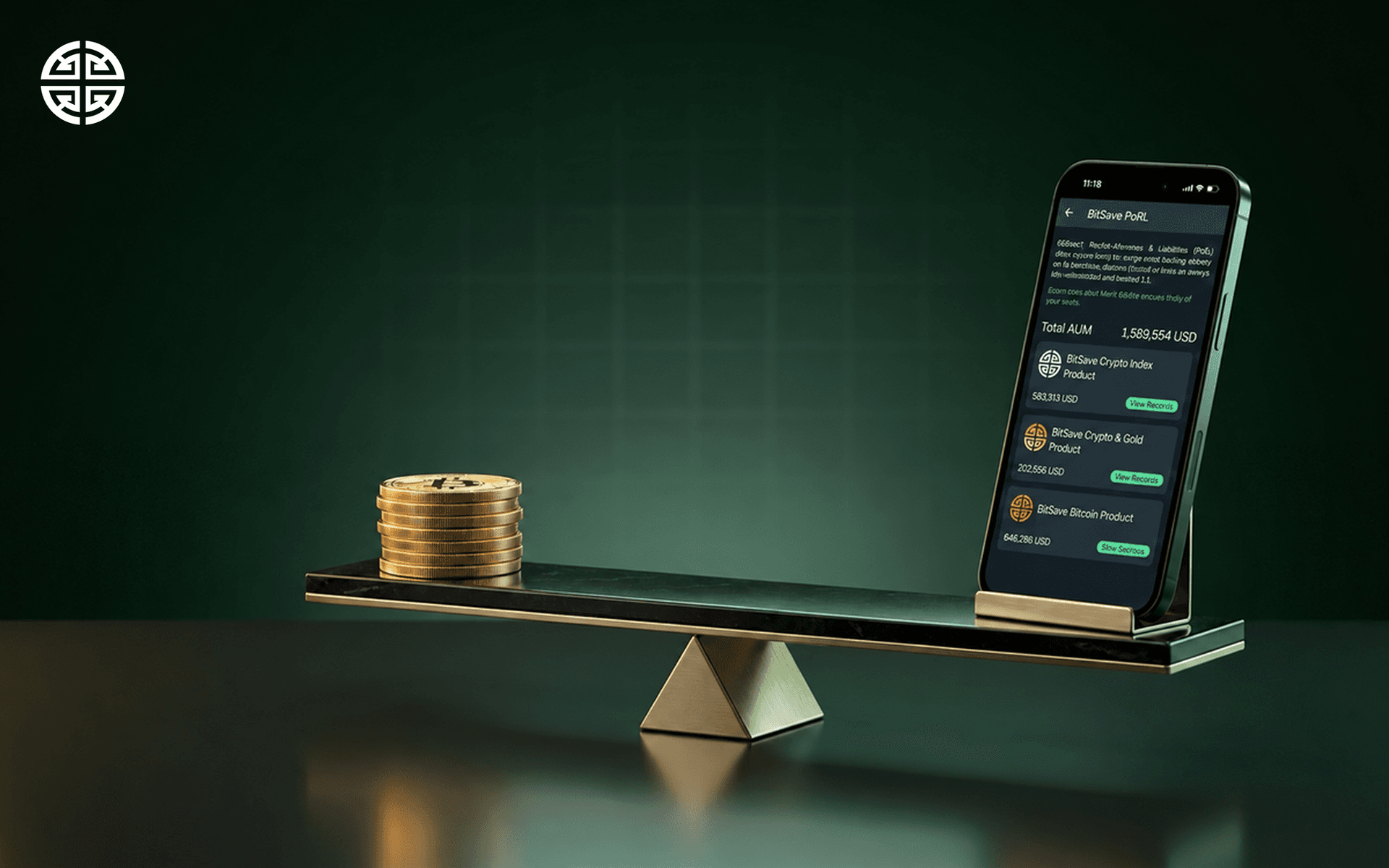
BitSave publishes Proof of Reserves and Liabilities (PoRL) for each product. Reserves and liabilities sit side by side. The figures are updated once a week, and the wallets can be checked on a public blockchain at any time.
The collateral BitSave needs is plain arithmetic: units issued multiplied by the price of the asset. If every investor redeemed today, BitSave would need 100% of that value. The PoRL shows it holding exactly 100%, not 99.99% and not 100.1%.
The third question is who publishes the check. BitSave's PoRL is self-published on-chain. Anyone can verify the wallets, but no outside firm attests to the reconciliation today. The last section of this article covers what that means.
Does proof of reserves show your own holding, or only the total?
On most platforms, including BitSave, proof of reserves shows the total. Some exchanges add a Merkle check that confirms your account is counted. BitSave does not, because investor money is pooled, but every purchase you make still leaves a separate record you can check yourself.
A Merkle tree bundles every account balance into a single fingerprint. Each user gets a proof that their balance is one of the pieces inside it, without seeing anyone else's.
At BitSave, money from all investors in a product is pooled and bought together at the respective product's Net Asset Value (NAV). There is no separate wallet or on-chain entry for each investor, and opening one for every investor would not be practical.
Your own record sits elsewhere. Each transaction carries 1% TDS, and TDS is reported to the income tax department. Every purchase, whether ₹1,000 or ₹10 lakh, therefore appears as its own line item in your Annual Information Statement (AIS) on the income tax portal. That is an independent record that the purchase was made on your behalf.
What does it mean when a platform keeps customer assets separate from company funds?
It means customer assets sit outside the company's own balance sheet, usually with a named custodian, so that they are not treated as the company's assets if it fails. The test is ownership: whether you hold a claim on the platform, or a recorded share of assets held for you.
On an exchange, the crypto in your account is usually a promise to deliver. In law you are often an unsecured creditor: you are owed the assets, and you stand in line with other creditors if something goes wrong. When a prominent Indian crypto exchange halted withdrawals after a security breach, its users found that what they held was a claim,and not their asset.
A BitSave unit token works differently. It records your share of assets held off BitSave's balance sheet, in bankruptcy-remote custody. BitSave's wallets are pooled, much like an exchange's, which is why the separation cannot be seen wallet by wallet. The distinction is ownership, not the wallet. The difference is set out in full in crypto investment platform vs exchange.
100% of client assets are held in cold storage with Liminal, a custodian regulated in Abu Dhabi Global Market (ADGM), through Chainberg, its institutional custody product. BitSave uses exchanges only to buy and sell, not to hold client assets.
The separation starts before custody. BitSave keeps its own operating money and investor money in separate accounts, explained in who holds what at BitSave.
How can you tell if a platform lends, stakes or rehypothecates your crypto?
Look in three places: the terms of use, any yield the platform offers, and whether its reserves stay at 100% of liabilities over time. A yield on deposits usually means the assets are being put to work. Reserves that dip below liabilities, even briefly, point the same way.
Lending means handing customer assets to borrowers for interest. Staking means locking an asset on its own network for a period in return for a yield, much like a fixed deposit. Rehypothecation means reusing assets deposited for one purpose as collateral for something else.
Each can be legitimate when a customer chooses it. The risk arises when it happens to assets the customer believes are simply being held.
BitSave does not lend or stake client assets. You do not have to take that on trust: the PoRL shows collateral at 100% of liabilities whenever you check it, which leaves no room for assets to be out on loan. How this fits into long-term holding is covered in the safest way to hold long-term crypto in India.
What does crypto insurance cover, and what does it not?
Crypto insurance covers specified events affecting the assets it is placed on, such as loss from the storage a custodian runs. It does not cover a fall in price. Before relying on it, check who the insurer is, which assets the policy sits on, and who holds the policy.
BitSave's cold-storage assets are covered by Lloyd's of London. The cover is placed by the custodian, Liminal, directly on the assets it holds.
Insurance protects against what happens to assets in storage. It does not protect an investment against the market. If Bitcoin falls 30%, the value of your units falls with it.
Cover described only as "shared", or with no insurer named, is worth a question before you invest.
How do you verify these safeguards on BitSave, step by step?
Start in the BitSave app, where each product shows its reserves, liabilities and collateral ratio. Then check the same wallets on a public blockchain explorer, outside the app. Finally, confirm the custodian, insurer and audit on BitSave's trust page. Each step takes a few minutes.
- Open the BitSave app. On the home page, scroll down to the card insured at Lloyd's of London and tap View Proof-of-Reserves.

- The PoRL page lists every product. Tap View Reserves on the one you want to check. The Bitcoin product is the simplest place to start.

- Compare Total Liabilities at the top, the units outstanding multiplied by NAV, with Total Assets below. The two should match. Expand Bitcoin (BTC) to see the collateral percentage, which should read 100%, and the wallets that hold the Bitcoin, each with its own View on Blockchain link.

- Tap View BitSave Tracker. It opens BitSave Tracker on X, which posts each product's units bought and sold every day, the total units in issue, the closing NAV and a link to the blockchain transaction. Tap View on Blockchain beside Contract to see the smart contract behind the product's unit tokens.


- For the Crypto Index product, expand each asset in turn. Collateral units multiplied by price gives that asset's collateral value. It should equal the required amount shown beside it, which is the asset's weight in the index, with collateral at 100%.

- Check the same wallets outside the app. Each View on Blockchain link opens the wallet on a public blockchain explorer, where the balance can be seen without a BitSave account. The Bitcoin product's wallets are:


- On the trust page, confirm the custodian (Liminal), the insurer (Lloyd's of London) and the cybersecurity audit (Grant Thornton).
If a figure in the app and the same wallet on the explorer do not match, that is the question to put to the platform.
What can you not verify yet, even on BitSave?
Three things. BitSave's proof of reserves is self-published, with no outside firm attesting to it. Its FIU-IND registration is in process, not granted as on date of writing this article. And SEBI does not regulate crypto, which means no Indian market regulator supervises crypto investing platforms. Knowing these limits is part of checking.
The PoRL sits on a public blockchain, which means anyone can check the wallets without asking or even being on the BitSave app. What is currently missing is an independent firm confirming the reconciliation.
The on-chain approach began out of necessity. In its early days, BitSave did not have the means for a reserve auditor. It published its wallets on the blockchain instead and treated the public record as being open for audit 24x7. Investors found it reassuring, and it became part of the product. Today an auditor or a wealth manager can verify 100% collateral from the app without asking for documents.
The Grant Thornton audit mandated by FIU-IND is a cybersecurity audit. BitSave was found compliant on all 26 domains. It checks security controls, not reserves. More on regulatory status is in is BitSave legal in India.
Access also runs through BitSave. The custodian holds the assets, but you reach them through BitSave's app and processes. What happens to your units if BitSave stops operating is covered in “how to withdraw crypto in India”.
FAQs
Which Indian platforms share live dashboards of reserves and custody?
Several Indian platforms publish proof of reserves, often as periodic reports. BitSave shows reserves and liabilities for each product in its app, updated weekly and checkable on a public blockchain at any time. When comparing, check whether liabilities are shown, how often figures change, and who publishes them.
What is multi-sig or MPC custody?
Both spread control of a wallet across several keys or parties, so that no single person can move assets alone. Multi-sig needs several separate signatures. MPC (Multi-Party Computation) splits one key into pieces held by different parties. BitSave's client assets are held in Liminal's institutional cold custody.
Is a cybersecurity audit the same as an audit of reserves?
No. A cybersecurity audit tests how systems and data are protected. An audit of reserves checks that assets exist and cover what is owed. BitSave's Grant Thornton audit is a cybersecurity audit. Its reserves are shown separately, through the PoRL.
Does crypto insurance cover a fall in price?
No. Insurance covers specified events affecting assets in custody, not market movement. If the price falls, the value of your holding falls with it.
Can I verify my crypto holdings on-chain or through a third-party auditor?
On BitSave you can verify each product's total reserves and liabilities on a public blockchain, with or without an account. Your own purchases appear as line items in your AIS. No third-party auditor attests to the reserves today.
What happens to my crypto if BitSave shuts down?
Client assets are held off BitSave's balance sheet, in bankruptcy-remote custody with Liminal, and do not count as BitSave's assets. The steps to withdraw in that case are in - “How to withdraw crypto in India”. Long-term holding options are compared in the safest way to hold long-term crypto in India.
Is BitSave regulated in India?
SEBI does not regulate crypto, and no Indian market regulator supervises crypto investing platforms. BitSave's FIU-IND registration is in process, and it has completed the FIU-mandated cybersecurity audit by Grant Thornton. More in is BitSave legal in India.
This article is for information only and is not investment, tax or legal advice. Crypto assets are volatile and you can lose money. Check current terms, tax rules and product details before you invest.