4 min read
The new Fintech: AI as the internet, blockchain as its settlement layer
Fintech put finance on our phones. The next layer is forming now: AI agents that buy data, compute and services around the clock, settling in stablecoins on public blockchains. Visa, Mastercard, Swift and central banks are already building it.

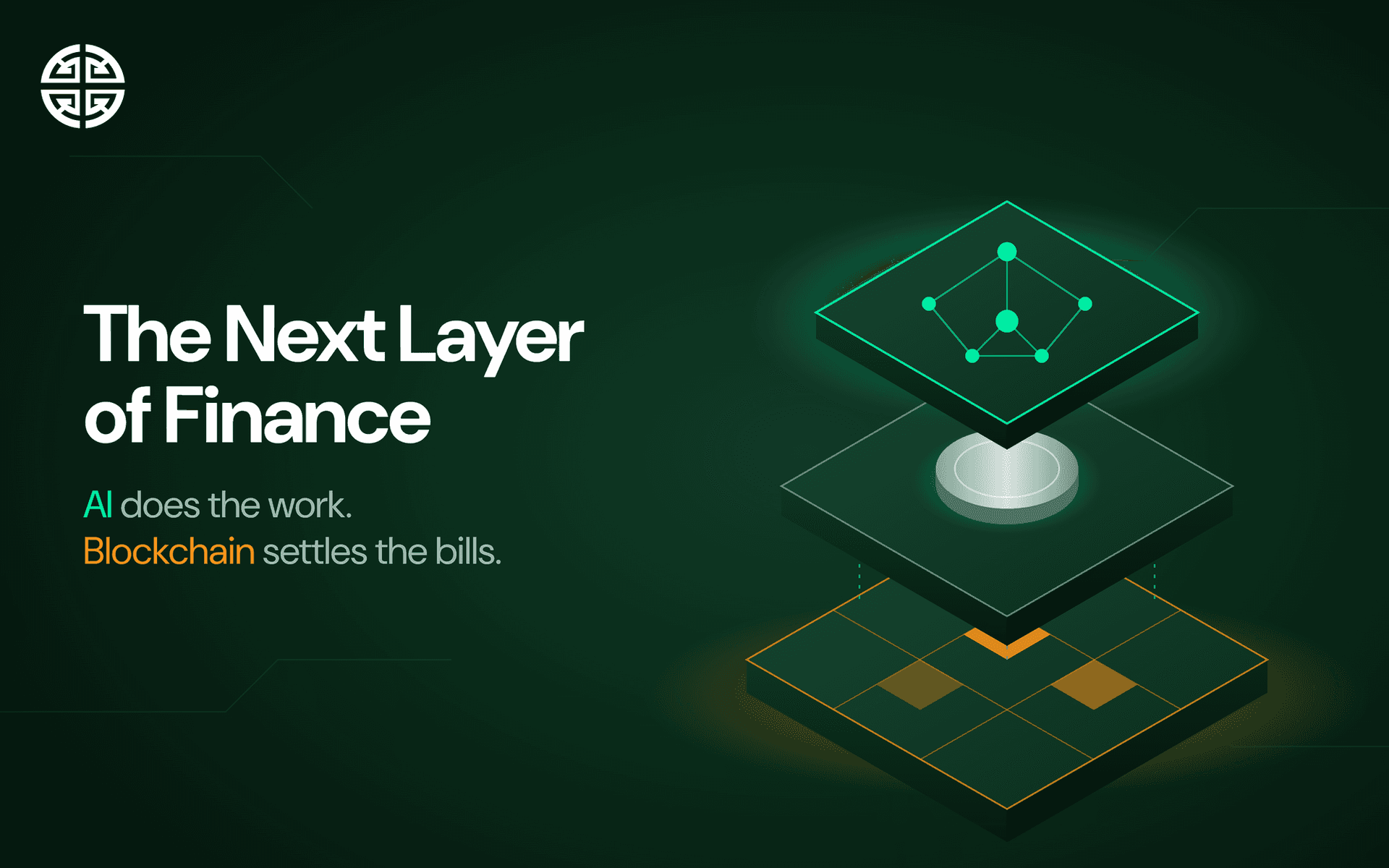
Fintech was finance being made accessible on the internet as the base layer. Over the last two decades or so, it moved account opening, payments and investing from a bank branch to our phones. But in today’s world, Fintech is now becoming passe and the next version is here and forming: AI as the new internet, and blockchain as the layer where its transactions settle.
AI is now a utility
Saying a company uses AI no longer sets it apart. It is expected, much as having a website was by 2005. What is scarcer now is how quickly a customer can reach a person on the other side who understands them.
Inside companies, AI is moving from assistants to agents, and from single agents to teams of them. Over dinner recently, our founding engineer explained why he could relax at the table. While we ate, a set of AI agents he had organised into a hierarchy, from a CTO agent to VPs to an engineering team, was writing and shipping code. He stepped in only when an executive decision was needed.
What agents pay with
The same agents that write code are increasingly set up to buy things: data, compute, API calls and services, in amounts from fractions of a rupee upward, across borders and at any hour. Which rails suit software that never stops working?
Correspondent banking was built for people and business hours. A cross-border transfer can pass through several banks, each with its own cut-off times and checks. A public blockchain runs every minute of every day and keeps a public ledger that anyone with an internet connection can verify. For moving value, agents need a unit that holds steady, and stablecoins are increasingly filling that role.
The early data points the same way. AI agents made more than 138 million payments through the x402 protocol on Base in the 12 months to July 2026, according to Chainalysis. In a study of frontier AI models, the models chose stablecoins for payments 53% of the time and Bitcoin for long-term savings 79% of the time. The scenarios were simulated rather than live, yet BlackRock cited the result in its September paper on what it calls the machine-native economy.

The incumbents are building it
The firms expected to resist this shift are building it:
- Visa moved stablecoin prefunding for Visa Direct into production in October, letting businesses fund cross-border payouts in USDC around the clock. Its stablecoin settlement was running at about $7 billion a year as of June.
- Mastercard launched Agent Pay for Machines in June with more than 30 partners. In its pilots, Coinbase supplied the agent wallet infrastructure and Base handled on-chain settlement.
- Swift announced in September 2025 that it is building a blockchain-based ledger with Consensys and more than 30 financial institutions.
- Then in October, the central banks of Malaysia and Thailand, as well as the World Bank and several commercial players, have joined a Monetary Authority of Singapore (MAS) initiative to advance cross-border settlement in digital money.

What issuers must hold
A dollar stablecoin is only as sound as its reserves. Under the US GENIUS Act, issuers back each token 1:1 with short-dated Treasuries, cash or equivalents. Stablecoin issuers held about $165 billion of US Treasury bills as of June 2026, roughly 2.5% of a $6.1 trillion market. Standard Chartered expects the stablecoin market to reach $2 trillion by end-2028, which it estimates would add $0.8 trillion to $1 trillion of bill demand.
The same logic applies to any currency. A stablecoin issued against it creates demand for that currency's government debt, deposits and cash equivalents. That helps explain why central banks are engaging with stablecoins rather than resisting them.
The pairing
Fintech put India’s payments and capital markets on our phones. My grandparents would have marvelled at how fast money now moves within India. To me, it is ordinary. The next step joins AI agents that transact around the clock with a settlement layer that never closes. My son will likely grow up treating that as ordinary too. My generation watched the internet go from novelty to utility, and we are now watching money make the same move.
Routine work shifts to software, payments clear on a public ledger, and demand rises for the currencies and sovereign debt behind the tokens.
The companies building this layer, among them Visa, Mastercard, Coinbase, BlackRock and JPMorgan, are already in most global investors' portfolios. Many investors who say they do not hold crypto but in fact, unknowingly already own its infrastructure.
Sources
[1] Chainalysis on North America crypto adoption 2026
[2] Bitcoin Policy Institute on AI models and money
[3] BlackRock, The Machine-Native Economy
[4] Visa on stablecoin prefunding for Visa Direct
[5] Mastercard on Agent Pay for Machines
[6] Swift on its blockchain-based ledger
[7] Monetary Authority of Singapore on cross-border settlement in digital money
[8] Tomasz Tunguz on stablecoin Treasury holdings
[9] Standard Chartered on stablecoins and T-bill demand
This article is for informational and educational purposes only and does not constitute financial, investment, legal, or tax advice. Nothing in this piece should be construed as a recommendation to buy, sell, or hold any security, crypto, or other asset. Markets are volatile, crypto assets in particular carry high risk, and past performance is not indicative of future results. Do your own research and consult a qualified, licensed advisor before making any investment decisions. The author may hold positions in the assets discussed.