5 min read
When Bonds Stop Being Safe: The Case for Gold and Bitcoin
Bond yields are hitting multi-decade highs across the US, Japan, and the UK at once. Rate hikes only explain part of it. The rest is a growing distrust in government debt. Here's why that matters for gold and Bitcoin, and what Japan's debt monetization tells us.

Bond Yields Are Rising
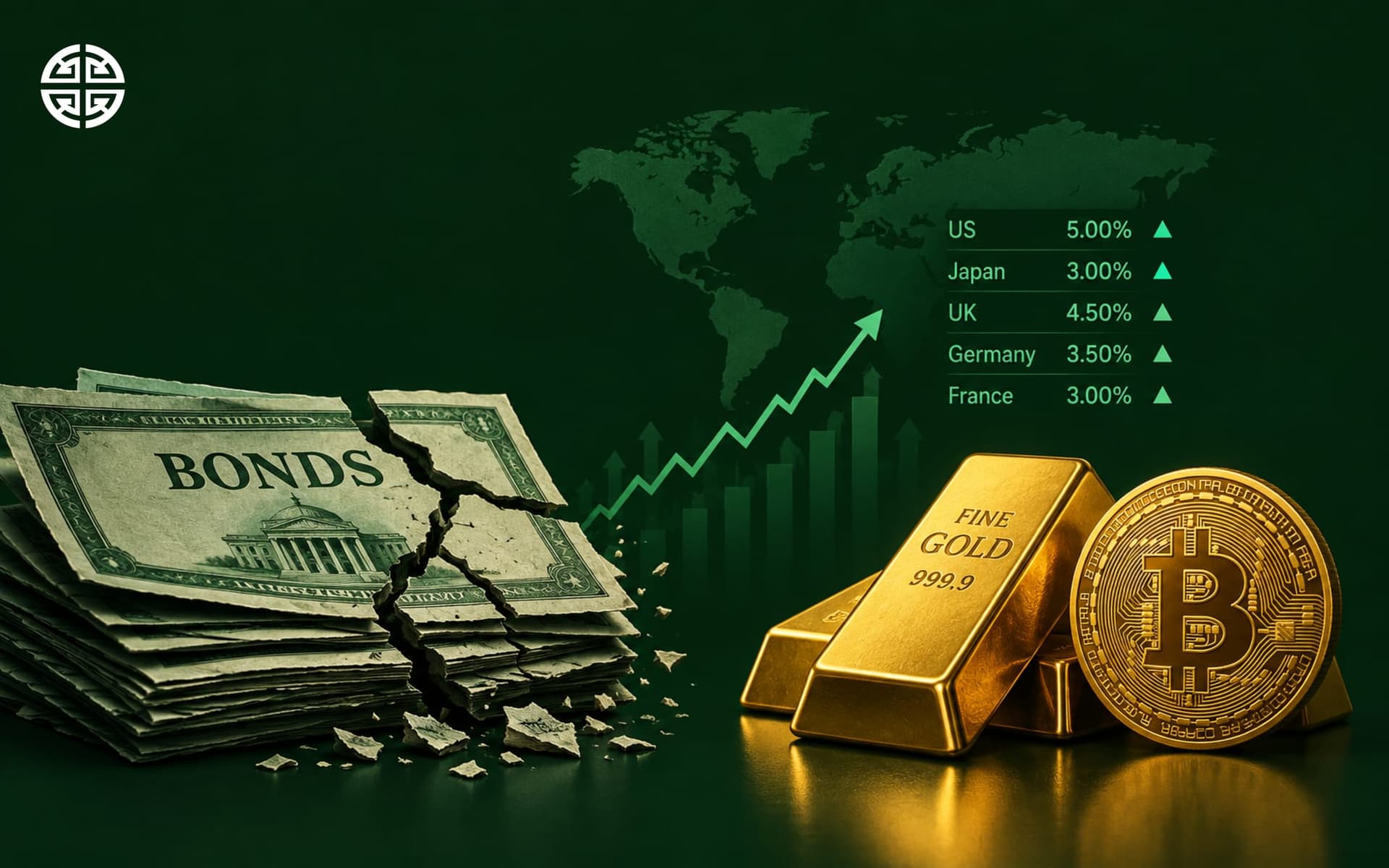
This isn't one country's problem. Every major bond market is feeling it at the same time. The US 10-year is above 5%, the highest in almost two decades. The 30-year sits at 5.37%. Japan's 10-year crossed 3% for the first time since 1996. The UK's 10-year is at its highest since 2008, and its 30-year is at levels last seen in 1998. Germany's 10-year is at 3.5%, its highest since 2011. France's 10-year is back to levels last seen around 2008.

This is happening in every major developed bond market at the same time. That simultaneity is the first thing worth sitting with, because a single country's fiscal mess doesn't explain it. Something structural is being priced across the board.
Why the Yields Are Rising: Term Premium
Central bank policy explains part of the move. The ECB hiked again in September, the Fed followed by taking rates to 3.75-4.00%, and the Bank of Japan raised its own rate to 1.25%, the highest level since 1995. But rate expectations alone don't account for the size of this move.
The rest is term premium, the extra compensation investors demand for holding long-dated debt when inflation, government borrowing, and market risk are uncertain. That premium has been rising fastest in Japan, France, and the UK, three of the countries with the weakest fiscal positions among major economies.
Term premium rising independent of what central banks are doing is the bond market's way of saying it no longer fully trusts that long-dated debt gets repaid in money worth what it's worth today. It's not a rates story anymore. It's a solvency story showing up inside the rates market.
The scale of the underlying debt problem makes that skepticism reasonable. Global government debt is near 94% of world GDP, with the IMF projecting 100% by 2029. Governments are now spending close to 3% of world GDP on interest payments alone, up from 2% just four years ago. Add in AI infrastructure spending, with the five largest US tech companies expected to spend around 697 billion dollars this year, an increasing share of it debt funded, and the competition for capital across sovereign and corporate borrowers keeps pushing yields higher regardless of any single central bank's next move.
Ray Dalio's Recommendation to Buy More Gold and Bitcoin and Sell Bonds
Ray Dalio made his position explicit on LinkedIn on August 21. His recommendation: underweight bonds, particularly longer dated Treasuries, and hold 10% to 15% of a portfolio in gold, plus a smaller position in Bitcoin. He puts a US debt crisis at roughly three years away, give or take two, if the current course isn't changed.

His reasoning is arithmetic already in progress, not speculation. US debt payments are set to exceed government revenue this year, reaching 11 trillion dollars. He's argued that gold and Bitcoin, as non-government produced monies, could perform relatively well if debt pressures eventually lead to currency debasement or inflation.
Dalio isn't calling for a wholesale rotation out of bonds. The trade he's describing isn't "dump every bond and go all in." It's closer to reshuffling where the safety in a portfolio sits: cut back on long-dated Treasuries, keep some short-term Treasuries for cash-like liquidity, and use gold and Bitcoin to cover the fiscal and currency risk that bonds used to cover on their own.
His own sizing is conservative too. He's called Bitcoin "a bit" of a position, up from the 1% to 2% he called reasonable back in 2022, and he's said before that Bitcoin can't fully replace gold as a store of value. The conviction is in the direction of the hedge, not in going all in on any single asset.
The Case of Japan: Debt Monetization
Japan already ran the sequence Dalio is warning about, and it isn't theoretical.
In March 2013, the Bank of Japan owned 11.6% of all Japanese government bonds. By March 2023, it owned 53.3%. The central bank stepped in as buyer because private demand wasn't sufficient to absorb the debt at prices the government could tolerate. That's debt monetization in practice: debt financed by central bank money creation rather than real market demand.
The cost landed on bondholders. Japanese government bonds lost 51% of their value against dollar denominated debt after 2013, and 76% against gold. Japan's four largest life insurers are now sitting on roughly 96 billion dollars in unrealized losses on their government bond holdings.
Rising yields were the early signal. Monetization was the government's response once that signal became politically unbearable to ignore. Currency and bond devaluation was the price paid by anyone still holding the debt when it happened.

Conclusion
The mechanical read on rising yields is that they're bad for Bitcoin and gold in the near term, since both are non-yielding assets and the opportunity cost of holding them goes up as yields climb. That's shown up in the data this year, including ETF outflows exceeding 1.5 billion dollars during the recent stretch of rising rates.
But the term premium component of this move tells a different story than the rate hike component does. Term premium rising without a matching fiscal correction makes the eventual monetization outcome more likely, not less, because raising real yields to whatever level actually compensates investors for true fiscal risk becomes politically unbearable for a government already spending close to 3% of world GDP on interest. Japan chose monetization over that outcome for over a decade. The US, UK, and France are showing early signs of the same term premium stress today.
That's what separates a short term headwind from a long term thesis. Gold and Bitcoin's core property, having no issuer who can inflate away what's owed to you, isn't a hedge against a hypothetical anymore. The bond market is currently pricing the early stages of the exact scenario that hedge exists for.
This article is for informational and educational purposes only and does not constitute financial, investment, legal, or tax advice. Nothing in this piece should be construed as a recommendation to buy, sell, or hold any security, crypto, or other asset. Markets are volatile, crypto assets in particular carry high risk, and past performance is not indicative of future results. Do your own research and consult a qualified, licensed advisor before making any investment decisions. The author may hold positions in the assets discussed.